Outlook 2016 For Mac Archiving
Posted : admin On 30.01.2019Note: When you run this rule for the first time, archiving may take a lot of time to complete depending on your mailbox size. • After the task completed you will find the.olm file with your mailbox items saved on the computer. • Confirm that items are in the file. Navigate to File > Import > Outlook for Mac archive file > choose the file. File will be displayed in the list of folders. If all items are in place, you may empty the Archive folder. Extract rar app mac. Outlook 2016 for Mac Important: Archive button is available only on Exchange 2016 To start using local Mac archiving, you would need to create the Archive folder.
In this article, you will find the instructions on how to archive mailbox data in Outlook 2011 and Outlook 2016 for Mac. Archiving is available when you enable the rule which is set up and run in your mailbox. The Archiving rule will help you move the data from the server to. Out the box Microsoft Outlook for Mac 2011 has no equivalent tool to the auto archive functionality found in Outlook for Windows. UPDATE: I have now released a new toolfor archiving in Outlook Mac 2011 which is a native Mac Application. It is significantly more stable, featured and faster than the AppleScript.
Note If you apply a retention policy to users who have an archive mailbox, the retention policy replaces the default MRM policy. You can create one or more retention tags with the Move to Archive action, and then link the tags to the retention policy. You can also add the default Move to Archive tags (which are created by Setup and linked to the Default MRM Policy) to any retention policies you create. Archive quotas Archive mailboxes are designed so that users can store historical messaging data outside their primary mailbox. Often, users use.pst files due to low mailbox storage quotas and the restrictions imposed when these quotas are exceeded. For example, users can be prevented from sending messages when their mailbox size exceeds the Prohibit send quota.
The archive file now appears in the navigation pane at the left; you can work with it there just as you would your main file. For even more thorough cleanup, choose File→Info→Mailbox Cleanup→Mailbox Cleanup.
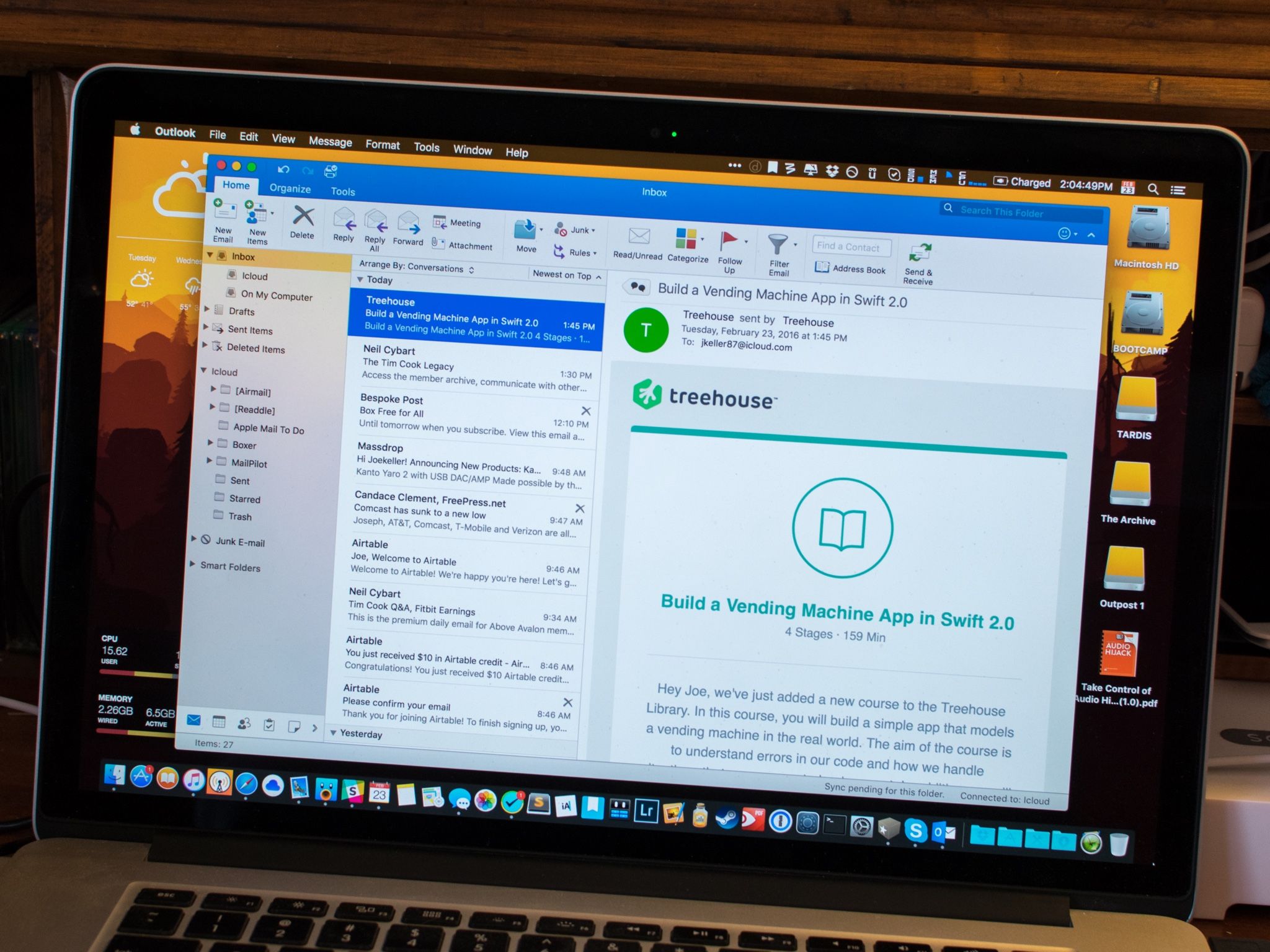
Outlook 2016 for Mac automatically organizes the inbox around threaded conversations, thereby simplifying the process of locating related messages. Often times, numerous messages are exchanged within the same thread. Other recipients will edit or truncate previous responses, making it difficult to confirm previous statements or reference information included in earlier emails. By grouping the messages together, this information (and others' responses) can more easily and readily be accessed. The new Outlook for Mac client also changes the way preview messages appear.
In Microsoft Outlook, the default AutoArchive setting for the Deleted Items folder is to permanently delete old items. When you configure the Microsoft Office Outlook Archive settings to permanently delete all old items, an Archive.pst file is automatically created even if you did not specify one to be created.
Configure the middle field as “is Greater than or equal to” and then configure the number of days (e.g. In the “Do the following:” section, choose “Move message” and then choose the archive folder you created in the previous step. Finally, check the box for Enabled and you’ve got a pretty simple automated rule to move messages off your Exchange server and onto your local computer. To move existing mail, click Rules from the Message menu and then click on the name of the rule. Once done, click on the Outlook menu and then click on Preferences. Click General and then in the Folder list section, check the box for “Hide On My Computer folders”.
Outlook 2016 users can also more easily propose new times for meeting invitations that don't work well with their schedule. Lastly, plus multiple calendars can be now viewed side-by-side, which is a long-present Windows feature that brings the time-saving views to the Mac. The Calendar view also shows the weather forecast, adding another elegant touch that, while seemingly small, proves surprisingly useful. What do you think of Outlook 2016 for Mac?
One could also do the following: • In the Outlook Menu Messages, look for the Move > option. See if there is a Archive (provider) menu option.
Anyway, if i can set up somehow auto archiving for Exchange account, pls, give me a hint - how. Just for your information: I have stand-alone Microsoft Office 2016 for Mac and Exchange account (inbox) is locating not in the server n our office, but in the cloud.
• • • • • • • • • • • Exporting and Importing Data in Outlook on Macintosh You can export an email account's messages, attachments, folders, contacts, calendar and appointments, tasks, and notes in Outlook as an '.olm' file as a way to save everything if the account is being disabled, or you simply want to 'archive' or store the data on a computer's hard drive instead of in the account space on the mail server. The.olm file can then be imported to Outlook to view, and, if desired, move the information to different set of folders, including any that are part of another email account (as long as the account is set up in Outlook and has enough available space). If you are exporting and importing because you are leaving CUMC, also be sure to when it expires to avoid getting errors when Outlook tries to connect.
This version has full support for OS X 10.10 Yosemite.
Please Choose Setup a New Backup Profile Step 5: You Will be presented options of Mail Clients > Choose Outlook Mac 2011 or Outlook Mac 2015 depending on which version you are using and proceed to next step Step 6: You will be presented with folder structure from Outlook Mac 2011 / 2015 Mail Accounts. Please select/ deselect the folders you would like to backup from Outlook Mac 2011 / 2015. Step 7: Now you are presented with Advanced options like Frequency of Mail backup ( select Automatic as its recommended or you may choose the days and time frame for backup), You may also choose to add and setup Mirror locations for multiple copies of backups for extra security. You May also activate the Auto USB Sync. So, whenever you connect the USB drive, It automatically copies and syncs a copy of local backup to the USB Disc in the background automatically. Step 8: Backup Profile is set up and now your emails are set to be backed up as per the options and settings you selected during the previous steps. Mail Backup X - officially Ready for OS X Mojave A must have Email Backup App for Millions of Mac user's and companies worldwide!
Click Rename and rename it to Delete, if desired. • Select the default Delete group and click Remove. The group you added should be selected. • Select Main Tabs from the Choose commands from field on the left.
An archive file in Outlook 2016 for Mac is a.olm file that you can save to any location on your Mac or on a different machine for safekeeping. You can export your email, contacts, calendars, tasks, or notes to the.olm archive file. Here’s how: • On the Tools tab, choose Export. • On the Tools tab, click Export. • In the Export to Archive File (.olm) box, check the items you want to export, and choose Continue. • Check the items you want to export.
• Outlook 2016 • If you, check the Items that are in the category option and use the drop down menu to select the category. • To export everything in Outlook (all account/folder headings in your Outlook list, including any existing On My Computer folders) you can choose Items of these types: and check which types of items (Mail, Calendar, Contacts etc.) to include. Click Continue when ready. • Outlook will prompt to choose a location to save the export file; be sure to keep it in a location you will remember. You can also re-name the file using the Save As field.
After the folder is created you would need to set up an archiving rule: • In Outlook 2011 for Mac, go to Tools > Rules. • Alternatively, go to Rules from the ribbon and select Edit rules: • Select Exchange on the left pane menu and click on ' +' to add a new rule: • Give the rule a name and specify the conditions using drop-down lists as follows: • If all conditions are met: Selected. • When a new message arrives: Date Received is greater than enter any number days old. Note: Outlook interface might be different and you will be prompted to specify After and Before dates. • Do the following: Move Message any folder on your computer. • Do not apply other rules to messages that meet these conditions: Enabling this option is up to you and depends on your other rules. • Enabled: Checked.
Retention tag name Tag type Description Default 2 year move to archive Default (DPT) Messages are automatically moved to the archive mailbox after two years. Applies to items in the entire mailbox that don't have a retention tag applied explicitly or inherited from the folder. Personal 1 year move to archive Personal Messages are automatically moved to the archive mailbox after one year.
• If there are contacts, tasks or other account items you want to include in the export, you will have to label these with the category as well. Categorized items will be marked with the color of the category label and are ready for export. Exporting • Select File in the upper left of the Outlook, the Export from the drop down menu. Click the right arrow at the bottom of the window to continue. • Select your desired option in the Delete After Exporting? Window, click the right arrow at the bottom, then move to step 3 below.
Once the exporting process is completed successfully, click on the Finish button 9. Now, you have to navigate to the destination folder where the files are saved.
• Outlook will begin exporting. It may take a while if a lot of items were selected. • An Export Complete message will appear, click Finish or Done to exit. The.olm (export) file will be in the location selected in step 4.
These rules don't carry over to your archive mailbox, however, and you can't redirect messages to your archive using an inbox rule.
Thank you for your reply. But i have to say, that i use Outlook 2016 with Exchange account! I do not see, how make auto archiving for it. For sure, i do understand, that i can create as many rules as folders i have, but it looks really stupid, like we use Office 1990, but not the Office 2016.
The option to include items with do not archive applies to items specifically set to do not archive, not folders. Thanks, appears complicated many places to go.Based on what you saying Auto Archive sets a global rule (File - Options- Advanced - AutoArchive-) selects where to move emails to & only allows one Archive File for entire Outlook. I have a personal Archive.pst & Business Archive & appears no way to set up each of these on own Archive File.Also Auto Archive will not allow me in July, for instance.Archive everything prior to December 31, 2017 to start new 2018 archive files (pst for business & personal).Only way it appears is to reset the global for entire outlook & reset each folder within 'data file' either personal or business for different Archive file (ie 2017 Archive Personal). A lot of manual effort I sometimes 300 - 400 emails daily in my business.Are my assumptions correct??? That applies to all items in the folder when you use autoarchive, but when you use the manual archive (not called clean up old items), not autoarchive, the option to 'include items with do not archive set' applies to individual items, not the folder's global props. If you archive based on autoarchive settings, it would honor the folder properties. In outlook 2013/2016, open a message then click the expander icon in the Tags group to bring up the Properties dialog.
But I do not want it to let me archive sent items - I want my sent items to be in my sent folder. I view messages in conversation mode, and after I send responses I tend to archive the whole conversation. Then when I go to sent items to view the most recent sent message, the only one in there is the very first originating sent message.
Some Guides suggest to just drag and drop emails to a folder on the desktop, however, it is just a pain to restore the emails or search through emails properly in case you ever end up with an Outlook crash or a Dead Mac. Manually Backing up Outlook Mac 2011 / 2016 Mails to an OLM Archive Another simple inbuilt option provided by Outlook is to export Outlook Mails to Outlook Mac Archive files (.olm) dumps time to time. So, in a case of a crash, you may use these to reimport the emails to your Outlook. In order to make it simpler, you may choose to • Setup by adding a new category in Outlook, name it ' Outlook Mac Backup'. • Add a new rule, and name it '30 days Outlook Mac Backup', choose to add all email with a date sent/received older than, 30 days.
To display the folder list, select View > Folder Pane. And choose Normal. How do I search the Archive Folder? By default, when you search for Outlook items by using the Search Current Mailbox feature at the top of your folder list, Outlook searches your entire mailbox. If you'd like to scope the search to your Archive folder only, first select the Archive folder in the folder list. Your search box will now search only the Archive folder.
Most users possess a love or hate relationship with Microsoft Outlook. Regardless of opinion, Outlook remains Microsoft's email client solution. Much improved over Entourage days, Outlook has increasingly offered Mac users a more reliable email platform that's worked well within Microsoft Exchange environments, whether the Exchange server is located locally or of the cloud-based variety. Introduces a refreshed interface, which is normal, of course, for new Office applications. The real question as to an office suite's refinement comes in the exploration of new features, of which Outlook 2016 boasts many.
• To export the data from Archive folder navigate to File > Export. On dialog window choose types of items that should be included in the archive file.
Users can access an archive mailbox in online mode only. Exchange ActiveSync No. Note In-Place Archiving is a premium feature and requires an Exchange Enterprise client access license (CAL).
You are here: » How to Scenerios? » How to Backup Outlook Mac 2011 / 2016 Mails on Mac How to Automatically Backup Outlook Mac 2011 / 2016 e-mails on Mac OS X?
Frequently Asked Questions 1. ‘Archive button missing’ Answer: If the email is set up via POP protocol then archive button would not show up. To fix it make sure that you configure the account into Outlook for Mac via Exchange or IMAP, instead of POP. ‘First time using the Archive’ Answer: If you are using the Archive for the first time then you will get a prompt: You have to select one option either Choose Another Folder or Continue Continue: If you select this option then a new folder will appear in your folder list for that email account. The folder is called Archive for Outlook.com, Google, Office 365, iCloud, and Yahoo! For Gmail, the archive folder is called All Mail.
Managing archive mailboxes In Exchange Server, creating and managing archive mailboxes is integrated with common mailbox management tasks. For step by step procedures, see. • Creating an archive mailbox: You can enable an archive mailbox for an existing mailbox or you can create an archive mailbox when creating a new mailbox. • Moving an archive mailbox: You can move a user's archive mailbox to another mailbox database on the same Mailbox server or to another server, independent of the primary mailbox. To move a user's archive mailbox, you must create a mailbox move request. For details, see. Important Locating a user's mailbox and archive on different versions of Exchange Server isn't supported.
This article will explain how to archive Mailbox data locally in Outlook for Mac 2016 Outlook 2016 for Mac To create Archive archive folder choose one or more messages that you would like to archive > chose Archive on the ribbon. As soon as you choose Archive, you will get a prompt The “Archive” folder for “Microsoft” does not exist > to proceed click Continue button.
• Click OK to save the rule. • Apply the rule by clicking on the source folder, then Rules > Apply > Name of the rule. • To export the data from the Archive folder navigate to File > Export. On dialog window choose types of items that should be included in the archive file. Click Continue. • On next dialog window type the name of the archive file and select the location on your computer, where the file should be stored. You may add the tags optionally.
The Archive folder will be automatically created. To set up archiving rule • In Outlook 2011 or 2016 for Mac, go to Tools > Rules. • Alternatively, go to Rules from the ribbon and select Edit rules: • Select Exchange on the left pane menu and click on ‘ +’ to add a new rule: • Give the rule a name and specify the conditions using drop-down lists as follows: • If all conditions are met: Selected. • When a new message arrives: Date Received is greater than enter any number days old. • Do the following: Move Message any folder on your computer. • Do not apply other rules to messages that meet these conditions: Enabling this option is up to you and depends on your other rules.